ThinkSuiteHomeAboutProjectsAI News
All AI Tools →
Lead Generation
Content Marketing
Video StudioSoon
Voice AISoon
Image StudioSoon
Contact
HomeAI NewsNVIDIANVIDIA Unveils Agentic & Physical AI for...
NVIDIAImpact: 98/100

NVIDIA Unveils Agentic & Physical AI for Graphics at SIGGRAPH 2026

NVIDIA made significant strides at SIGGRAPH 2026, showcasing how agentic and physical AI are set to revolutionize graphics, simulation, and digital world creation. Key announcements included new tools for AI-driven content creation, advanced neural rendering techniques, and an open world model for local physical AI, redefining realism and automation across industries.

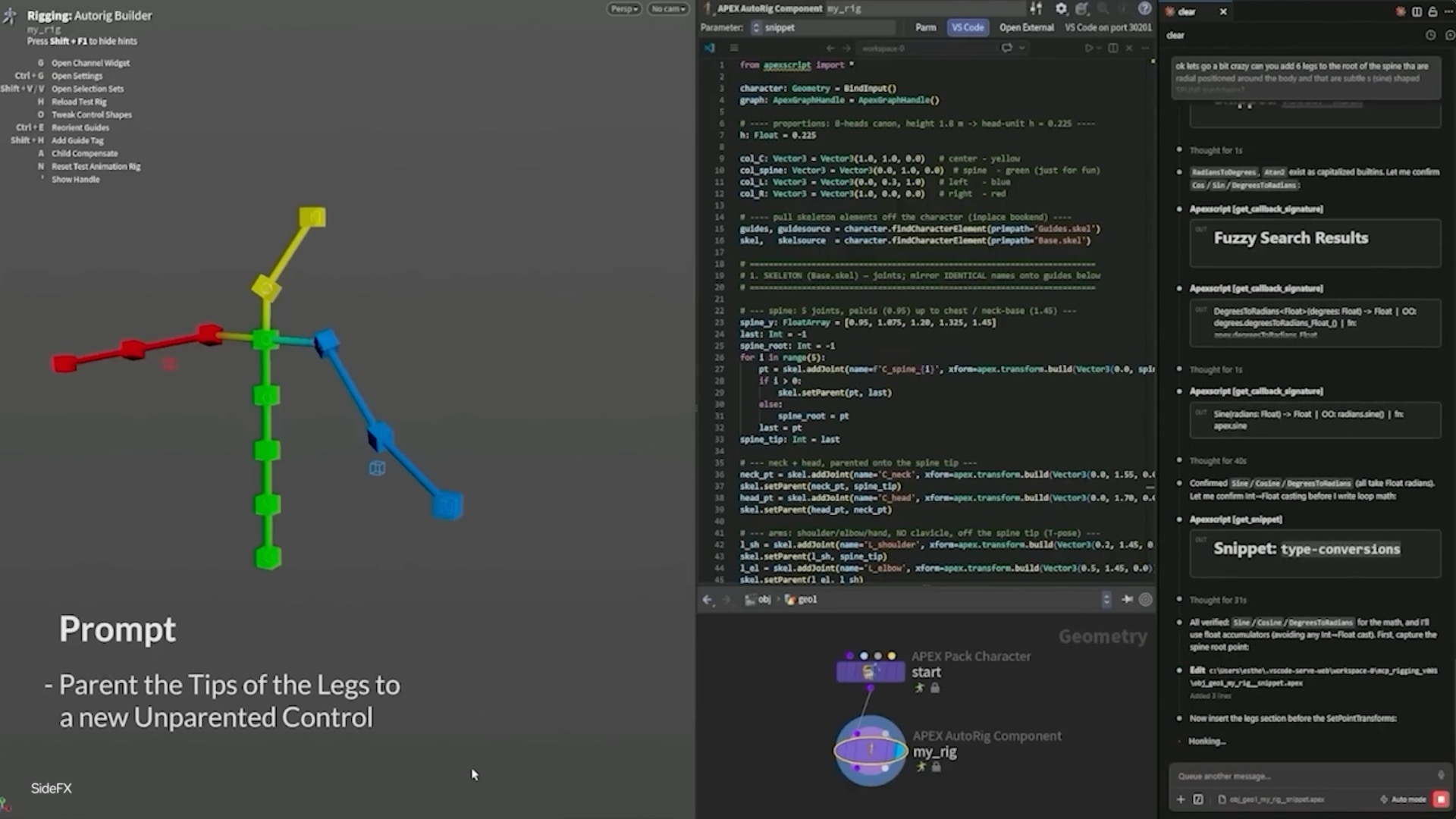
NVIDIA Unveils Agentic & Physical AI for Graphics at SIGGRAPH 2026
📷 Image: NVIDIA Blog

Key Highlights

  • NVIDIA introduces Agentic AI for intelligent content creation via Model Context Protocol.
  • New Cosmos 3 Edge open world model enables local, high-fidelity physical AI simulation.
  • Unveiling of a Synthetic Video Detector NIM microservice for responsible AI.
  • Demonstration of NVIDIA NemoClaw on DGX Station with NVIDIA Agent Toolkit for AI agent development.
  • Advances in 3D-guided neural rendering to accelerate realistic digital world creation.

NVIDIA Ignites Graphics Revolution with Agentic and Physical AI at SIGGRAPH 2026

Los Angeles, CA – At the highly anticipated SIGGRAPH 2026 conference, NVIDIA once again took center stage, unveiling groundbreaking advancements in AI that promise to fundamentally transform how digital worlds are created, understood, and interacted with. The company’s keynote, led by NVIDIA AI research and engineering leaders Neil Ashton, Edward Liu, and Ming-Yu Liu, highlighted a new era where agentic and physical AI converge with neural rendering and sophisticated simulation methods to build virtual environments with unprecedented fidelity.

What Happened: A Vision for AI-Powered Worlds

NVIDIA's keynote at SIGGRAPH 2026, held on July 20th, was a masterclass in future-forward technology, demonstrating how AI is not just assisting but actively creating the next generation of graphics and simulations. The core message resonated with NVIDIA founder and CEO Jensen Huang's introductory remarks: the goal is to create "virtual worlds that behave with the fidelity and realism of the physical world." This vision extends beyond entertainment, impacting industrial design, robotics, and autonomous systems.

The presentation showcased a suite of innovations designed to empower creators and engineers with tools that expand imagination, offer creative freedom, and ensure precise realization of their visions. Edward Liu initiated the showcase by delving into 3D-guided neural rendering, a technique poised to streamline the creation of highly realistic 3D assets and environments.

Key Details: NVIDIA's SIGGRAPH 2026 Breakthroughs

NVIDIA and its partners unveiled several pivotal technologies and initiatives at SIGGRAPH 2026, each a testament to the company's commitment to advancing AI-driven graphics and simulation:

  • Model Context Protocol Connections for Agentic AI in Content Creation: This innovation enables AI agents to understand and interact with creative tools and workflows, automating complex tasks and assisting artists in generating content more intelligently and autonomously.
  • New Synthetic Video Detector NIM Microservice: Addressing the growing challenge of deepfakes and AI-generated media, this NVIDIA Inference Microservice (NIM) provides a powerful tool for detecting synthetic video, emphasizing responsible AI development.
  • Cosmos 3 Edge Open World Model for Local Physical AI: Spearheaded by Ming-Yu Liu's Cosmos Lab, this model brings sophisticated physical AI capabilities to edge devices, allowing for highly realistic and responsive simulations and interactions in localized environments without constant cloud connectivity.
  • NVIDIA NemoClaw on DGX Station with NVIDIA Agent Toolkit: Demonstrating a robust platform for developing and deploying advanced AI agents, NemoClaw running on a DGX Station, combined with the NVIDIA Agent Toolkit, provides developers with the computational power and software framework to build complex agentic AI systems.
  • Research Breakthroughs for Virtual Worlds and Physical AI: Beyond specific products, NVIDIA highlighted ongoing research pushing the boundaries of virtual world creation and the integration of AI that understands and simulates physical laws.

These announcements collectively paint a picture of a future where AI is not just a computational engine but an active participant in designing, simulating, and interacting with digital realities.

Technical Analysis: Unpacking the AI Advancements

NVIDIA's SIGGRAPH revelations underscore a strategic push into Agentic AI and Physical AI, leveraging their expertise in neural rendering and world models. These concepts are at the heart of transforming digital content creation and simulation.

  • Agentic AI for Content Creation: The Model Context Protocol is a crucial enabler. It allows AI models to act as intelligent agents within creative applications, understanding context, making decisions, and executing tasks autonomously. Imagine an AI assistant that not only generates textures but understands the artistic style, adapts to user feedback, and even suggests design variations based on the project's overall vision. This moves beyond simple generative AI to truly collaborative, intelligent systems.
  • Physical AI and World Models: Cosmos 3 Edge represents a significant leap. Physical AI refers to AI systems that accurately model and predict the behavior of real-world physics within a digital environment. This is critical for robotics, autonomous vehicles, and industrial digital twins where simulations must precisely mirror reality. By making Cosmos 3 Edge an open world model and enabling local deployment, NVIDIA is democratizing access to high-fidelity physical simulation, reducing latency, and enhancing privacy and security for edge applications.
  • Neural Rendering and 3D-Guided Creation: Edward Liu's emphasis on 3D-guided neural rendering signifies a paradigm shift from traditional 3D pipelines. Instead of meticulously modeling every detail, neural networks learn from data to generate highly realistic 3D assets and scenes, guided by simpler inputs. This dramatically accelerates content creation, making photorealistic virtual worlds more accessible and scalable.
  • NIM Microservices and Agent Toolkit: The introduction of the Synthetic Video Detector as a NIM microservice highlights NVIDIA's strategy for deploying AI models as easily consumable, containerized services. This simplifies integration for developers. Concurrently, the NVIDIA Agent Toolkit provides the foundational framework for building, testing, and deploying agentic AI, making sophisticated AI development more accessible on powerful platforms like the DGX Station.

Industry Impact: Reshaping Digital Frontiers

These advancements are poised to create seismic shifts across multiple industries:

  • Gaming & Entertainment: Expect hyper-realistic graphics, dynamic game worlds that react intelligently, and AI-powered NPCs (Non-Player Characters) that exhibit human-like intelligence and agency, pushing the boundaries of immersive storytelling.
  • Industrial Design & Manufacturing: Digital twins will become even more accurate and predictive, allowing for precise simulation of product performance, factory operations, and complex engineering scenarios, leading to faster innovation cycles and reduced costs.
  • Robotics & Autonomous Systems: The ability to simulate physical worlds with extreme fidelity, coupled with agentic AI for decision-making, will accelerate the training and deployment of robots and autonomous vehicles, making them safer and more capable in real-world scenarios.
  • Content Creation & Media: Artists and designers will gain powerful new co-pilots, automating tedious tasks and unlocking new creative possibilities through AI-driven generation and contextual understanding. The Synthetic Video Detector also becomes a critical tool for maintaining trust in digital media.

Future Implications: The Next Era of Digital Reality

NVIDIA's announcements at SIGGRAPH 2026 are not just about incremental improvements; they represent a foundational shift towards a future where digital and physical realities are increasingly intertwined. The emphasis on AI building AI, as seen in world models and neural rendering, points to a self-improving ecosystem of digital creation. The vision of "virtual worlds that behave with the fidelity and realism of the physical world" suggests a future where digital twins are indistinguishable from their real-world counterparts, and AI agents can navigate, understand, and interact with these worlds as intelligently as humans.

This paves the way for truly dynamic and adaptive metaverses, intelligent design platforms, and autonomous systems that can learn and evolve within highly realistic simulated environments before deployment. The ethical considerations around synthetic media and agent autonomy will also become increasingly prominent as these technologies mature and become more widely adopted. NVIDIA is clearly positioning itself at the forefront of this next era, providing both the hardware and the software stack to realize these ambitious visions.

Why It Matters

This suite of announcements from NVIDIA at SIGGRAPH 2026 marks a pivotal moment for the AI industry, demonstrating a significant leap in how intelligent systems interact with and create digital realities. For developers, the NVIDIA Agent Toolkit and NIM microservices offer powerful, accessible tools to build sophisticated AI agents and integrate advanced capabilities like synthetic video detection directly into their applications. The local deployment of Cosmos 3 Edge also opens doors for edge AI applications requiring high-fidelity physical simulation without cloud dependency, fostering innovation in robotics and autonomous systems. For businesses, these advancements translate into unprecedented opportunities for efficiency, realism, and innovation across diverse sectors. From accelerating product design with AI-powered creative tools to deploying hyper-realistic digital twins for manufacturing and logistics, companies can leverage these technologies to gain a competitive edge. The ability to simulate complex physical environments locally and with high accuracy will revolutionize training, testing, and operational planning, significantly reducing costs and risks. The broader AI industry benefits from NVIDIA's continued push into agentic and physical AI. These developments solidify the roadmap for truly intelligent virtual worlds and embodied AI, where systems can understand, predict, and interact with their environments in a physically coherent manner. This not only propels research forward but also sets new benchmarks for what's possible in generative AI, simulation, and the eventual realization of sophisticated, interactive metaverses and autonomous machines.

📈

Market Impact

NVIDIA's latest innovations at SIGGRAPH 2026 are set to profoundly impact the AI market, further solidifying its dominant position in both hardware and software for AI-driven graphics and simulation. By providing comprehensive tools for agentic and physical AI, NVIDIA increases the stickiness of its ecosystem, making it harder for competitors like AMD and Intel to catch up in specialized AI workloads. This will likely drive increased demand for NVIDIA's GPUs, DGX systems, and software platforms, potentially widening the performance gap. The announcements will also spur investment in companies leveraging these new capabilities, particularly in sectors like AI-powered content creation, advanced simulation, robotics, and digital twin technology. We can expect a surge in startups and established firms integrating NVIDIA's Agent Toolkit and NIMs to build next-generation applications. While increasing NVIDIA's market share, these developments also put pressure on cloud providers to offer optimized infrastructure for these advanced AI models, potentially leading to deeper partnerships with NVIDIA or increased competition in AI service offerings.

💻

Developer Impact

Developers and technical teams will find a wealth of new capabilities and tools to explore. The NVIDIA Agent Toolkit, coupled with platforms like NemoClaw on DGX Station, provides a robust framework for building and deploying sophisticated AI agents that can interact intelligently within complex environments. This will empower developers to create more dynamic, autonomous applications, from intelligent NPCs in games to self-optimizing industrial robots. Furthermore, the Model Context Protocol offers a new paradigm for integrating AI directly into content creation pipelines, allowing developers to build AI co-pilots that understand context and assist with intricate design tasks. The availability of NIM microservices, such as the Synthetic Video Detector, simplifies the integration of advanced AI functionalities, enabling developers to quickly deploy specialized AI models without deep expertise in model optimization. The Cosmos 3 Edge model will be particularly impactful for edge computing developers, allowing them to create highly realistic, local simulations for real-time applications without relying on constant cloud connectivity, opening up new possibilities for embedded AI and IoT.

🔮

Future Prediction

In the next 30 days, we'll see initial developer experimentation and community discussions around the NVIDIA Agent Toolkit and Cosmos 3 Edge, with early demos showcasing agentic AI in creative tools. Within 90 days, expect to see more refined prototypes and proof-of-concept applications emerging, particularly in gaming and industrial simulation, as developers integrate NIMs and leverage neural rendering for accelerated content creation. By 180 days, the first commercial applications leveraging these new agentic and physical AI capabilities will likely be announced, demonstrating tangible business value in areas like advanced digital twins, autonomous system training, and AI-assisted content production pipelines, solidifying NVIDIA's vision for AI-powered virtual worlds.

NVIDIA's SIGGRAPH 2026 announcements underscore a strategic pivot towards making AI an active, intelligent participant in the creation and simulation of digital worlds, rather than just a processing engine. The introduction of 'Agentic AI' through the Model Context Protocol is particularly significant; it moves beyond mere generative AI to systems that can understand context, intent, and act autonomously within complex creative workflows. This has profound implications for the democratization of high-end content creation, potentially enabling smaller teams to achieve results previously requiring massive resources. The focus on 'Physical AI' with Cosmos 3 Edge, especially its local deployment capability, is a game-changer for industries relying on accurate simulations, such as robotics, automotive, and industrial digital twins. It addresses critical issues of latency, data privacy, and robust operation in edge environments. The integration of 3D-guided neural rendering further streamlines the creation of photorealistic assets, significantly reducing the bottleneck in generating high-quality 3D content. Opportunities abound for developers to build intelligent co-pilots, create more dynamic and responsive virtual environments, and accelerate autonomous system development. However, risks are also present. The power of generative AI, while creatively liberating, necessitates robust tools like the Synthetic Video Detector NIM to combat potential misuse and misinformation. As AI agents become more autonomous, ethical considerations around control, bias, and accountability will become paramount, requiring careful architectural design and governance frameworks.

ThinkSuite AI Analysis

Frequently Asked Questions

What is Agentic AI in the context of NVIDIA's announcements?

Agentic AI refers to AI systems that can understand context, make decisions, and act autonomously within environments, particularly creative tools and simulations. NVIDIA's Model Context Protocol allows AI agents to intelligently assist and automate tasks in content creation workflows, moving beyond simple generative capabilities.

How does Physical AI differ from traditional simulation?

Physical AI, as demonstrated by NVIDIA's Cosmos 3 Edge, involves AI models that accurately learn, predict, and simulate real-world physics within digital environments. Unlike traditional simulations that rely on pre-programmed rules, Physical AI can adapt and generate realistic behaviors, making it crucial for applications like robotics and autonomous systems where high fidelity to physical laws is essential.

What is the significance of the Synthetic Video Detector NIM microservice?

The Synthetic Video Detector NIM (NVIDIA Inference Microservice) is a tool designed to identify AI-generated or manipulated video content. Its significance lies in addressing the growing challenge of deepfakes and misinformation, providing developers and businesses with an easily deployable, powerful AI service to verify the authenticity of video media and promote responsible AI use.

Sources

NVIDIA Blog

Want AI intelligence for your business?

ThinkSuite builds AI-powered systems, automation, and custom tools for forward-thinking companies.

Talk to Us →