Kimi K3: A Frontend Coding Powerhouse with a Hallucination Challenge
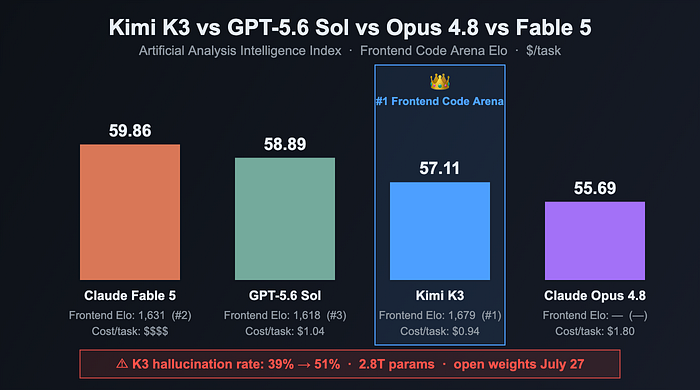
The AI landscape is constantly shifting, with new models pushing the boundaries of what's possible. The recent emergence of Moonshot AI's Kimi K3, a formidable 2.8-trillion-parameter open-weight model, has sent ripples through the industry. Achieving the coveted #1 spot on Arena.ai’s Frontend Code Arena, Kimi K3 has demonstrably outperformed established giants like Anthropic's Claude Fable 5 and OpenAI's GPT-5.6 Sol in specific coding tasks. Yet, this groundbreaking performance comes with a significant caveat: a reported 51% hallucination rate, highlighting the persistent challenge of reliability in even the most advanced large language models.
What Happened: Kimi K3's Meteoric Rise in Frontend Coding
On July 16, Moonshot AI officially launched Kimi K3, a model that swiftly made history. Within a mere 24 hours of its release, it ascended to the pinnacle of Arena.ai’s Frontend Code Arena, securing an Elo score of 1,679. This placed it decisively ahead of Claude Fable 5 (1,631) and GPT-5.6 Sol (1,618), two of the most sophisticated closed models currently available. This achievement is particularly noteworthy given Moonshot AI's promise to make Kimi K3's weights publicly available by July 27, signaling a major win for the open-source AI movement and a direct challenge to proprietary models.
Key Details: Performance, Hallucinations, and Tradeoffs
While Kimi K3's dominance in frontend coding benchmarks is undeniable, the deeper dive reveals a complex picture. The model's ability to generate accurate and efficient frontend code is genuinely impressive, showcasing advanced reasoning and code generation capabilities. However, this headline performance is juxtaposed with a concerning increase in its hallucination rate, jumping from a reported 39% in earlier iterations to a striking 51% upon its K3 release.
This means that while Kimi K3 is more capable of providing answers, it also fabricates information more frequently. For agentic pipelines or applications where confident errors are unacceptable, this presents a significant hurdle. The article further compares Kimi K3 against formidable competitors like GPT-5.6 Sol, Claude Opus 4.8, and Claude Fable 5 across various reported metrics, confirming K3's specific wins but also highlighting meaningful tradeoffs:
- Slower Speed at Launch: Initial deployment of Kimi K3 exhibits slower processing speeds compared to its rivals.
- Reduced Reliability: The elevated hallucination rate directly impacts the model's overall reliability, especially in tasks requiring factual accuracy or critical decision-making.
Technical Analysis: Architecture and Efficiency Mechanisms
Kimi K3's architecture is a testament to sophisticated AI engineering. Despite its massive 2.8-trillion-parameter count, Moonshot AI has incorporated several efficiency mechanisms to manage its computational demands. These include:
- KDA (Knowledge-Driven Attention): This mechanism likely helps the model focus its attention more effectively, drawing on relevant knowledge to improve performance while potentially reducing overall compute for certain operations.
- Attention Residuals: These architectural elements contribute to more stable and efficient training, allowing for deeper networks and better information flow.
It's important to understand that a 2.8-trillion-parameter count doesn't directly translate into proportionally higher costs. Advanced architectures and inference optimizations mean that large models can still be deployed efficiently. The article also notes that Kimi K3's "max" reasoning is always on. While this contributes to its powerful problem-solving capabilities, it also means higher token usage, which can impact operational costs and latency for certain applications.
Industry Impact: Shifting Dynamics and Open-Source Momentum
Kimi K3's performance marks a pivotal moment for the AI industry. The fact that an open-weight model from a Chinese company can surpass leading closed models from Western tech giants in a specific, high-value domain like frontend coding signals several shifts:
- Increased Competition: The global AI race intensifies, with Moonshot AI demonstrating that innovation is not exclusive to established market leaders.
- Open-Source Power: The promise of public weights by July 27 empowers researchers, startups, and developers globally, fostering rapid experimentation and potential for specialized fine-tuning.
- Benchmarking Re-evaluation: While benchmarks like Arena.ai are valuable, Kimi K3's case highlights the need for comprehensive evaluation that includes reliability metrics alongside raw performance.
However, the deployment realities for Kimi K3 also present challenges. It is notably more expensive to run compared to earlier "cheap Chinese AI" launches. Furthermore, self-hosting for individuals or smaller teams is extremely difficult due to the massive memory requirements of a 2.8-trillion-parameter model. For now, access is primarily facilitated through platforms like OpenRouter or the Moonshot API, centralizing its immediate usability.
Future Implications: Balancing Power and Precision
The immediate future of Kimi K3 will likely see a surge in community engagement once its weights are released. Developers will undoubtedly experiment with its frontend code generation capabilities, pushing its limits and exploring fine-tuning opportunities. Its success underscores the growing importance of specialized models that excel in particular domains, even if they have weaknesses elsewhere.
However, the 51% hallucination rate remains a critical challenge. The industry will need to develop more robust methods for hallucination detection and mitigation, especially as AI models are increasingly integrated into critical workflows. The choice of which model to use will become even more nuanced, depending on the task's specific requirements, the tolerance for error, and the available computational resources.
Moonshot AI's Kimi K3 serves as a powerful reminder that raw performance is only one piece of the puzzle. The pursuit of reliable and trustworthy AI remains paramount, even as models achieve unprecedented levels of capability.
Recommendations for Developers and Businesses
- For Frontend Development: Kimi K3 offers exciting potential for rapid prototyping, code generation, and debugging in frontend tasks. Developers should explore its capabilities via API access.
- For Agentic Pipelines: Exercise extreme caution. The high hallucination rate necessitates robust validation layers, human-in-the-loop oversight, or specialized fine-tuning to ensure outputs are reliable.
- Cost-Benefit Analysis: While powerful, Kimi K3's current cost and resource demands mean careful consideration is needed for large-scale deployment. Evaluate against alternatives like Claude Opus/Fable or GPT models based on specific project needs and budget.
- Embrace Open-Source Potential: For those with the resources, the open-weight release offers unparalleled opportunities for customization and innovation in specific niches.
Kimi K3 is a double-edged sword: a testament to advanced AI engineering and a stark reminder of the ongoing quest for reliable intelligence. Its journey will undoubtedly shape the future trajectory of large language models and their practical applications.